
Starting a clothing brand sounds exciting until you reach the manufacturing stage. Many new brands do not have the budget, storage space, or customer base needed to order hundreds or thousands of garments at once. This is where a low MOQ clothing manufacturer can make a major difference.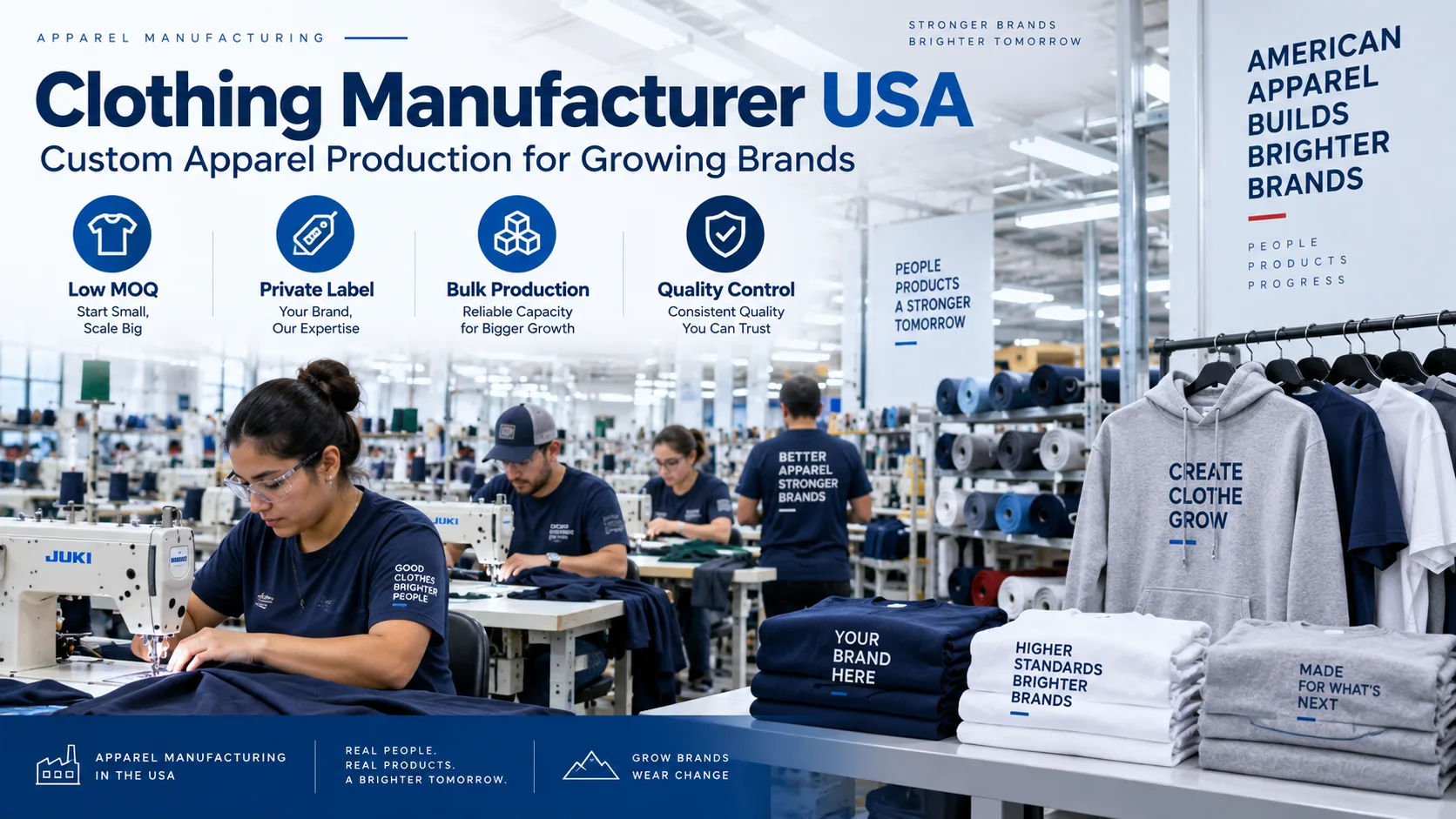
MOQ means “minimum order quantity.” It is the smallest number of pieces a manufacturer agrees to produce for one order or style. Traditional clothing factories often require large quantities because bulk production helps them cover fabric, labor, setup, and operating costs. A low MOQ clothing manufacturer works differently by allowing smaller brands to start with a more manageable production quantity.
For an emerging fashion label, working with a low MOQ clothing manufacturer can reduce the financial risk of launching a new product. Instead of committing to a huge inventory before knowing whether customers will buy it, a brand can produce a smaller batch, test the market, collect feedback, and then increase production when demand becomes clearer.
What Does MOQ Mean in Clothing Manufacturing?
MOQ stands for minimum order quantity. In simple terms, it tells you the minimum number of garments a factory requires you to purchase.
For example, a manufacturer may have a standard MOQ of 500 pieces per design. Another factory may accept 100 pieces, 50 pieces, or even fewer depending on the product and production process.
MOQ is not always calculated in exactly the same way. Some manufacturers set the MOQ per style, while others calculate it per color, fabric, or size.
Suppose you want to produce a hoodie in black, grey, and cream. A factory might require 100 pieces per color. Your total order would therefore be 300 hoodies.
Another factory might allow 100 pieces across all three colors. That difference can have a significant impact on the amount of money you need to invest.
How Does a Low MOQ Clothing Manufacturer Work?
The process is generally similar to working with a traditional garment factory, but the quantity is smaller.
The first step is usually discussing your clothing concept with the manufacturer. You provide information about the garment, including its style, fabric, colors, measurements, decoration, labels, packaging, and expected quantity.
The manufacturer then reviews the requirements and determines whether the order is suitable for its production setup.
If the factory accepts small orders, it may provide a quotation based on the number of pieces and the complexity of the garment.
Small production runs can have a higher price per piece than large orders. This is normal because many manufacturing costs remain similar regardless of whether the factory produces 50 pieces or 500 pieces.
Once the price and specifications are agreed upon, the manufacturer normally moves toward sampling.
The Sampling Stage
Sampling is one of the most important parts of clothing production.
Before producing the complete order, the manufacturer may create a sample based on your specifications. This gives you an opportunity to check the garment before spending money on the full production run.
You can inspect the fabric, stitching, measurements, color, print, embroidery, labels, and overall appearance.
If something is wrong, you can request changes.
For example, you might discover that the sleeves are too short or the fabric is thinner than expected. Fixing these problems during sampling is much easier than discovering them after receiving 100 finished garments.
A good low MOQ clothing manufacturer should be willing to communicate clearly during this stage.
Why Do Manufacturers Offer Low MOQs?
You may wonder why a factory would accept smaller orders when larger orders are usually more profitable.
There are several reasons.
Some manufacturers specialize specifically in supporting startups, independent fashion labels, boutique businesses, and online sellers.
Others use flexible production systems that allow them to switch between smaller orders efficiently.
Some factories may also have relationships with fabric suppliers that allow them to purchase smaller quantities of materials.
In other cases, the manufacturer may combine production orders or use existing production capacity to handle smaller runs.
The exact reason depends on the factory.
What Products Can Be Made With Low MOQs?
Low MOQ production is not limited to one particular type of clothing.
Depending on the manufacturer, you may be able to produce:
-
T-shirts
-
Hoodies
-
Sweatshirts
-
Tracksuits
-
Joggers
-
Dresses
-
Shirts
-
Jackets
-
Activewear
-
Children's clothing
-
Loungewear
-
Uniforms
-
Streetwear
-
Fashion accessories
However, the MOQ can vary significantly between products.
A simple cotton T-shirt may be easier to manufacture in small quantities than a complicated jacket containing multiple panels, zippers, linings, and specialized hardware.
The more complicated the garment, the more production setup may be required.
What Affects the Cost of a Small Clothing Order?
One of the biggest mistakes new brands make is assuming that a smaller MOQ automatically means a cheap order.
It does not.
A low MOQ clothing manufacturer may charge more per garment because fixed production costs are spread across fewer pieces.
Consider a simple example.
If a factory spends $500 preparing machinery, cutting materials, creating patterns, and setting up production, that cost has to be recovered somehow.
With 500 garments, the setup cost is spread across many products.
With 50 garments, the same cost is spread across only 50 products.
That is why the price per piece may be higher for smaller orders.
Other factors affecting the cost include fabric type, garment construction, printing, embroidery, trims, labels, packaging, shipping, and quality requirements.
Custom Design vs. Ready-Made Designs
Not every low MOQ manufacturer operates in exactly the same way.
Some factories offer fully custom manufacturing. This means you provide your own design and the manufacturer creates the garment according to your specifications.
Other manufacturers offer ready-made or semi-custom products.
For example, they may already have a basic hoodie pattern. You can choose the fabric, color, logo, embroidery, print, and label without creating an entirely new garment pattern.
This option can be much easier for a new brand.
Fully custom production generally requires more development work, while private-label or semi-custom production may allow a faster launch.
How Design Specifications Are Shared
Clear specifications are extremely important.
A manufacturer needs enough information to understand exactly what you want.
A typical clothing specification may include garment sketches, measurements, fabric details, color references, stitching requirements, placement of logos, label information, and packaging instructions.
Some brands create a technical package, often called a tech pack.
A tech pack can include measurements, construction details, artwork, materials, and other production instructions.
The better your information, the less room there is for misunderstanding.
Even a simple drawing is better than explaining a design entirely through casual messages.
How Quality Control Works
Quality control becomes especially important when you are ordering a small quantity.
You may think a smaller order automatically makes quality problems less serious, but the opposite can sometimes be true.
If you receive 50 garments and 10 have major defects, you have already lost 20% of your inventory.
A manufacturer should have a process for checking garments during and after production.
Quality checks can cover measurements, stitching, fabric defects, color consistency, printing, embroidery, zippers, buttons, labels, and general construction.
Ask the manufacturer how quality inspections are handled before placing a larger order.
It is also useful to agree on acceptable tolerances for measurements.
Clothing measurements can have minor variations because garments are sewn and finished by hand or machinery. However, major differences should not be accepted simply because the order is small.
Shipping and Packaging Considerations
Production is only one part of the process.
Once the clothing is finished, it needs to be packed and shipped.
Your total cost therefore includes more than the manufacturing price.
Depending on your location and the manufacturer's location, shipping may involve air freight, sea freight, courier services, or another transportation method.
For small quantities, express shipping can sometimes make sense because the shipment is relatively light.
However, shipping costs can become expensive when products are individually packaged or require special handling.
Before approving an order, ask for a complete quotation that clearly separates production, packaging, shipping, and any additional charges.
Advantages of Using a Low MOQ Clothing Manufacturer
The biggest advantage is lower inventory risk.
A new brand does not need to spend a large amount of money on products before testing demand.
Small production also makes experimentation easier.
You can launch one design, observe customer reactions, and decide whether it deserves a larger production run.
This approach is particularly useful for social media brands and online stores where trends can change quickly.
Another advantage is variety.
Instead of investing heavily in one design, you may be able to test several designs in smaller quantities.
For example, a new streetwear brand could launch three hoodie designs with smaller quantities rather than putting its entire budget into one design.
Disadvantages of Low MOQ Production
Low MOQ manufacturing is not perfect.
The most obvious disadvantage is the higher unit cost.
You may pay more per garment than a brand ordering thousands of pieces.
Fabric choices can also be limited.
Some suppliers require minimum fabric quantities, which means a manufacturer may not be able to offer every color or material for a tiny order.
Customization may also be restricted.
Certain embroidery, printing, dyeing, or garment-washing processes require setup costs that make very small orders difficult.
Production times can also vary. Small orders are not automatically faster because the manufacturer still needs to fit your project into its production schedule.
How to Choose the Right Manufacturer
Do not choose a factory simply because it advertises the lowest MOQ.
Look at the complete picture.
Start by checking whether the manufacturer has experience producing the type of clothing you want.
A factory that specializes in sportswear may not be the best choice for luxury dresses. Likewise, a manufacturer experienced in basic T-shirts may not have the equipment needed for complicated outerwear.
Ask about samples, production timelines, materials, quality control, packaging, payment terms, and shipping.
Communication matters too.
If the manufacturer takes days to answer basic questions before receiving your money, communication may become even more difficult once production begins.
A reliable low MOQ clothing manufacturer should be reasonably clear about what it can and cannot do.
Questions to Ask Before Placing an Order
Before confirming production, ask practical questions.
What is the minimum quantity per style?
Is the MOQ calculated per color or total order?
How much does sampling cost?
Can the sample cost be deducted from the production order?
What fabrics are available?
Can I provide my own fabric?
What are the production lead times?
How is quality checked?
What happens if defective garments are delivered?
What packaging options are available?
What payment schedule is required?
How much will shipping cost?
Getting these answers early can prevent expensive surprises later.
Low MOQ Does Not Mean Low Quality
Some new brands assume that small-batch manufacturing is automatically associated with poor quality.
That is not necessarily true.
Quality depends on materials, workmanship, production controls, specifications, and the manufacturer's standards.
A small order can be excellent if the manufacturer understands the product and follows clear specifications.
In fact, producing a smaller initial batch can be a smart way to evaluate a manufacturer's quality before committing to a much larger order.
This is one reason sampling and test orders are so useful.
When Should You Increase Your Order Quantity?
The purpose of starting small is usually to learn.
Once your products begin selling consistently, you can consider increasing production.
Larger orders may reduce your cost per piece because fabric purchases, labor, setup, and other expenses are distributed across more garments.
However, do not increase your order simply because the manufacturer offers a lower unit price.
Look at actual sales data.
If customers are consistently buying a particular hoodie, for example, increasing the production quantity may make sense.
If a design is sitting in storage, producing another 1,000 units simply because the price is cheaper per piece can create a much bigger problem.
How Low MOQ Supports New Fashion Brands
Starting a clothing company requires more than designing attractive products.
You need to understand your customers, pricing, marketing, inventory, packaging, shipping, and cash flow.
Large manufacturing commitments can put pressure on all of these areas.
Small-batch production gives new brands more flexibility.
You can learn what customers like without committing your entire budget to one collection.
This is especially useful for independent designers who are funding their business themselves.
A small order can act as a market test.
If customers respond positively, the next order can be larger.
If they do not, you have lost less money and can adjust your approach.
Common Mistakes to Avoid
One common mistake is focusing only on MOQ.
A factory offering 20 pieces may look attractive, but if the garment quality is poor or the shipping cost is extremely high, the deal may not actually be good.
Another mistake is approving production without checking the sample carefully.
Do not assume that the final garments will automatically match your expectations.
Also avoid unclear communication.
If you want a specific shade, measurement, fabric weight, stitching style, or logo placement, document it.
Finally, do not ignore payment terms.
Understand how much you need to pay upfront and when the remaining balance is due.
Is a Low MOQ Manufacturer Right for Your Brand?
A low MOQ manufacturer is often a strong option for startups, small fashion labels, online sellers, independent designers, and businesses testing a new product.
It is particularly useful when your budget is limited or demand is uncertain.
However, it is not automatically the best choice for every established brand.
A larger company with predictable demand may benefit from ordering larger quantities at a lower unit cost.
The right approach depends on your budget, sales volume, product complexity, and growth strategy.
Conclusion
A low MOQ clothing manufacturer gives smaller brands a practical way to enter the clothing market without making a massive inventory commitment from day one. Instead of ordering hundreds or thousands of garments immediately, a brand can start with a smaller production run and use real customer feedback to guide future decisions.
The process usually involves discussing the design, confirming the MOQ, reviewing costs, creating samples, approving specifications, producing the garments, checking quality, and arranging packaging and shipping. While the price per garment may be higher than with bulk manufacturing, the reduced inventory risk can be extremely valuable for a new business.
The smartest approach is to look beyond the minimum quantity. Compare quality, communication, sample policies, materials, production times, payment terms, customization options, and shipping costs before choosing a supplier.
For a growing fashion brand, starting small can actually be a strength. It gives you room to test designs, understand customer demand, correct mistakes, and improve your products before investing heavily. Once you know what sells, you can gradually increase production and negotiate better pricing.
In my experience, the best manufacturing decision is not always the one with the lowest price or smallest MOQ. It is the one that gives your brand the right balance between quality, cost, flexibility, and manageable risk. A carefully selected low MOQ clothing manufacturer can provide exactly that balance and give a new clothing business a much safer path toward sustainable growth.